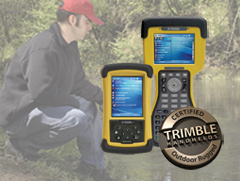


Here’s what you get when you take your Recon out of the box. An important tip to remember is you need to fully charge the NiMH battery before connecting it to the Recon—about 12 hours. After that, you’re ready to go!
Monday, January 22, 2007


Wednesday, January 10, 2007
Now it’s your turn
| Now that you’ve seen how we test our rugged handhelds, it’s your turn. Tell us about the rough outdoor conditions where you use the Recon or Ranger. Share your stories, pictures and videos, and we’ll post them here. Remember, everybody who contributes gets a Trimble hat, and we’ll give out bigger prizes for the best stories. | |
Accelerated life testing
| How do you pack years of real-world use when you don’t have years to complete a test program? That’s where accelerated life testing comes in. You’ll see how one of our accelerated testing machines performs hundreds of thousands of taps on the Ranger’s touchscreen and keypad—the equivalent of a complete product lifecycle—in just six to 18 hours. | |
Prototype testing lab
| You could call our prototype testing lab the Torture Chamber. It’s where we bake, freeze and soak our rugged handhelds before they go to a third-party lab for certification. You’ll see handhelds going through extreme temperature testing in our 65º C chamber and -35º C deep freeze. And you’ll see a MIL-STD immersion test, where we sink a running Recon in 1 meter of water. | |
Friday, December 29, 2006
Environmental Testing
This video explains some of the environmental testing we use on the Ranger and Recon rugged handhelds. You'll see pictures of testing in the dust chamber, drop tests onto concrete, water jets and water immersion tests. Don't try these with a commercial-grade handheld!
Welcome to the Trimble Outdoor Rugged Video Blog
Hello, and welcome to our vlog (video blog). This is the place to learn about mobile computing in the great outdoors. You’ll get to meet the engineers who design and test Trimble’s Ranger and Recon rugged handhelds. Ask them questions and see their answers.
And it’s not just our story—it’s yours, too. Tell us how you’re using your Ranger or Recon and the kind of rough conditions you work in. Even better—show us. Send us your pictures and videos, and we’ll post them here. For a limited time, everybody who contributes gets a free Trimble hat, and we’ll give out bigger prizes for the best stories.
Just how do we test Trimble rugged outdoor handhelds?
That’s the question we’re going to answer in this first set of videos. We take our rugged specifications very seriously and we want to show you how our handhelds earn the right to be called “Outdoor Rugged.” You can’t just drop it a few times or toss it in a fish tank and call it rugged (although you can see the Recon in our lobby fish tank here). We put them through a rigorous battery of tests for shock, vibration, immersion, dust and extreme temperatures (you can download our White Paper for the specific testing protocols). And we don’t just test our products in the lab. We take them out in the field and put them to work. We drop them, get them dirty, get them wet, and put them through the same kind of punishment you do.
Big storm shows the need for outdoor rugged handhelds
We shot our first video the day after a big storm hit the Pacific Northwest, knocking down trees and knocking out power all over the region. You can hear the chain saws in the background as utility workers clear away some of the storm debris. Harsh outdoor conditions would destroy most mobile computers, but the rugged Ranger and Recon are built to take on even the worst weather.
About Dale Kyle
Dale Kyle is the Rugged Handhelds Product Manager at Tripod Data Systems, a Trimble company. He has more than 15 years of experience in product development, systems testing, quality assurance and customer support for GPS and other navigation hardware and software.
Subscribe to:
Posts (Atom)